Sulfide Minerals · uncommon
Stibnite
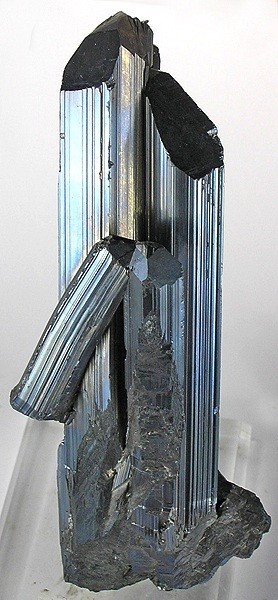
Stibnite is antimony sulfide, the chief ore of antimony. It is famous for brilliant steel-gray metallic crystals that form long, slender, often curved or radiating prismatic blades with perfect lengthwise cleavage.
Also known as: Antimonite, Antimony glance, Gray antimony.
Stibnite properties at a glance
| Type | Sulfide Minerals |
|---|---|
| Chemical formula | Sb2S3 |
| Mohs hardness | 2 |
| Crystal system | orthorhombic |
| Luster | metallic |
| Streak | Lead gray |
| Cleavage | Perfect lengthwise |
| Fracture | Subconchoidal |
| Specific gravity | 4.6 |
| Transparency | opaque |
| Common colors | Lead gray, Steel gray, Silvery gray |
| Rarity | uncommon |
Geology & background
Stibnite forms in low-temperature hydrothermal veins and hot-spring deposits and is the most important ore mineral of antimony.
Stibnite has been used since antiquity as a source of antimony and as a black eye cosmetic, and modern mining of the mineral supplies antimony for alloys, batteries, and flame retardants.
How to identify Stibnite
- Look for bright metallic steel-gray prismatic blades, often curved or radiating, with striations along their length.
- Very low hardness near 2 and perfect lengthwise cleavage are strong identifying features.
- A lead-gray streak and high density help separate stibnite from similar gray metallic minerals.
Full Stibnite identification guide: checklist, home tests and look-alikes →
Stibnite photos
Stibnite vs similar stones
Not sure it isn't something else? Side-by-side comparisons with the stones most often confused with Stibnite.
Where Stibnite is found
Stibnite occurs in low-temperature hydrothermal veins, with notable specimen localities in China, Japan, Romania, Bolivia, France, and the United States.
How much is Stibnite worth?
| Entry-level specimen | $10 |
|---|---|
| Typical collector specimen | $120 |
| Premium specimen | $1500+ |
Value depends on crystal size, luster, intactness of blades, locality, and overall aesthetics.
Common uses
- Primary ore of antimony
- Antimony alloys and flame retardants
- Historic cosmetic and pigment material
- Collector specimens
Interesting facts
- Spectacular stibnite clusters from the Ichinokawa Mine in Japan are among the most prized mineral specimens ever found.
- Powdered stibnite was used in antiquity as the dark cosmetic kohl.
- Stibnite is soft enough to be scratched by a fingernail in some cases and bends easily.
- Antimony from stibnite has long been used to harden lead alloys and as a flame retardant.
Care & safety
Stibnite is very soft, brittle, and easily bent or scratched, so blades damage readily.
Contains antimony. Stibnite contains antimony; wash hands after handling, keep it away from food, and do not ingest material.
Avoid inhaling dust. Do not cut, grind, or polish specimens without eye protection and a proper respirator.
Stibnite FAQ
What is Stibnite?
Stibnite is antimony sulfide, the chief ore of antimony. It is famous for brilliant steel-gray metallic crystals that form long, slender, often curved or radiating prismatic blades with perfect lengthwise cleavage.
How much is Stibnite worth?
Entry-level Stibnite specimens sell for around $10, a typical collector specimen for about $120, and premium pieces for $1500 or more. Value depends on crystal size, luster, intactness of blades, locality, and overall aesthetics.
How hard is Stibnite?
Stibnite has a Mohs hardness of 2. A fingernail (Mohs 2.5) scratches it easily.
Where is Stibnite found?
Notable sources of Stibnite include China, Japan, Romania, Bolivia, France, and United States. Stibnite forms in low-temperature hydrothermal veins and hot-spring deposits and is the most important ore mineral of antimony..
What is Stibnite used for?
Stibnite is used for primary ore of antimony, antimony alloys and flame retardants, historic cosmetic and pigment material, and collector specimens.