
Comparison · Minerals
Bornite vs Chalcopyrite
Bornite and Chalcopyrite are easy to confuse because both are minerals. Both sit near Mohs 3–3.25, so a scratch test alone will not separate them. Lean on luster, streak and heft instead. Below is a side-by-side comparison of their properties and the quick tests that separate them.
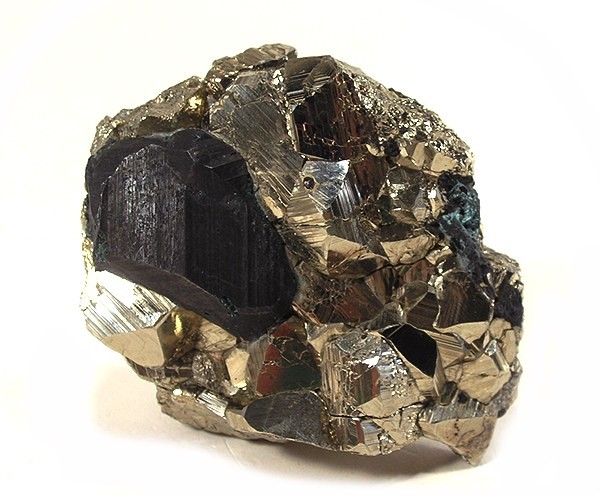
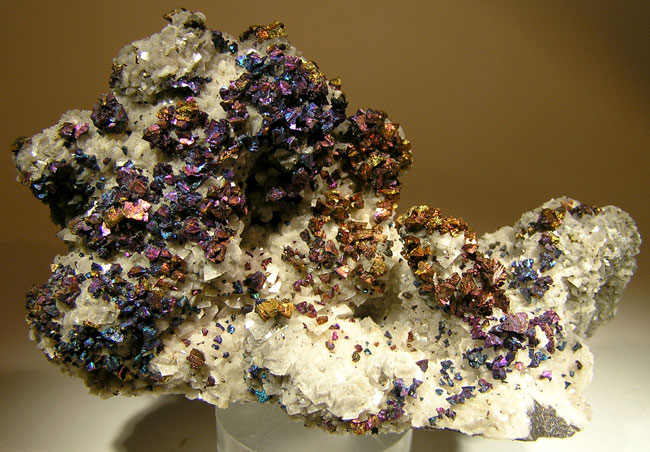
Key differences between Bornite and Chalcopyrite
- Both sit near Mohs 3–3.25, so a scratch test alone will not separate them. Lean on luster, streak and heft instead.
- Streak color differs: Bornite leaves a grayish black streak on unglazed porcelain, Chalcopyrite leaves greenish black.
- Both look metallic, so compare color, tarnish and weight rather than shine.
- Bornite feels noticeably heavier for its size (specific gravity 4.9–5.3 versus 4.1–4.3 for Chalcopyrite).
- They overlap in multicolored, but Bornite also comes in brown, red, orange, blue, and purple and Chalcopyrite also comes in yellow.
- Well-formed crystals give it away: Bornite is Orthorhombic (pseudocubic), Chalcopyrite is Tetragonal.
Bornite vs Chalcopyrite properties
| Property | Bornite | Chalcopyrite |
|---|---|---|
| Type | Minerals | Minerals |
| Mohs hardness | 3–3.25 | 3.5–4 |
| Luster | Metallic | Metallic |
| Streak | Grayish black | Greenish black |
| Transparency | Opaque | Opaque |
| Specific gravity | 4.9–5.3 | 4.1–4.3 |
| Crystal system | Orthorhombic (pseudocubic) | Tetragonal |
| Common colors | Copper red to brownish bronze (fresh), Iridescent purple-blue tarnish (peacock ore) | Brass yellow, Golden yellow, Iridescent tarnish |
| Rarity | common | common |
| Typical specimen value | $2–$150+ | $2–$150+ |
Which is more valuable?
Typical specimens of Bornite and Chalcopyrite trade in a similar range, around $20.
About Bornite
Bornite is a copper iron sulfide mineral with the formula Cu5FeS4, prized by mineral collectors for the flashy iridescent tarnish that earns it the nickname peacock ore. Freshly broken surfaces show a coppery, brownish-bronze metallic color that oxidizes within hours to purple, blue, and pink iridescence. It is an important, though secondary, copper ore mineral found in many sulfide deposits worldwide.
About Chalcopyrite
Chalcopyrite is copper iron sulfide, CuFeS2, and the single most important ore mineral of copper worldwide. It crystallizes in the tetragonal system, usually as tarnished brassy-yellow masses or small tetrahedral-looking crystals in hydrothermal veins. Its softness relative to pyrite and its greenish-black streak are the quickest ways to separate it from that more famous fool's-gold mineral.
Bornite vs Chalcopyrite FAQ
Is Bornite the same as Chalcopyrite?
No. Both are minerals, but they are distinct species with different hardness, streak or luster. Both sit near Mohs 3–3.25, so a scratch test alone will not separate them. Lean on luster, streak and heft instead.
How can you tell Bornite from Chalcopyrite?
Both sit near Mohs 3–3.25, so a scratch test alone will not separate them. Lean on luster, streak and heft instead. Streak color differs: Bornite leaves a grayish black streak on unglazed porcelain, Chalcopyrite leaves greenish black. Both look metallic, so compare color, tarnish and weight rather than shine.
Which is harder, Bornite or Chalcopyrite?
Chalcopyrite is harder: Mohs 3.5–4 against Mohs 3–3.25 for Bornite.
Which is more valuable, Bornite or Chalcopyrite?
Typical specimens of Bornite and Chalcopyrite trade in a similar range, around $20.

