
Comparison · Minerals
Baryte vs Calcite
Baryte and Calcite are easy to confuse because both are minerals. Both sit near Mohs 3–3.5, so a scratch test alone will not separate them. Lean on luster, streak and heft instead. Below is a side-by-side comparison of their properties and the quick tests that separate them.
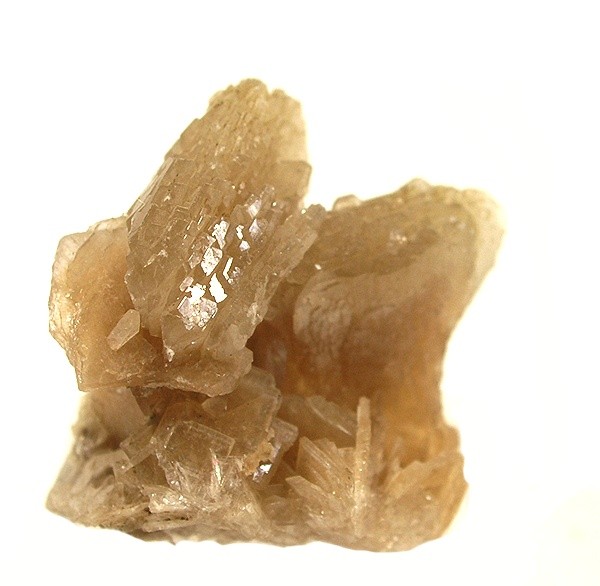
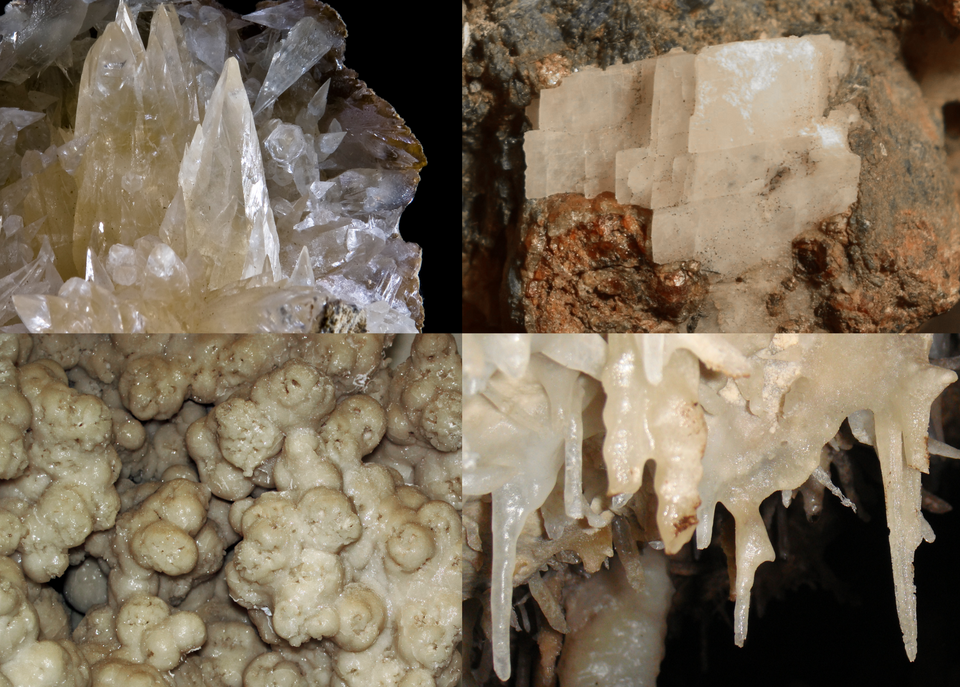
Key differences between Baryte and Calcite
- Both sit near Mohs 3–3.5, so a scratch test alone will not separate them. Lean on luster, streak and heft instead.
- Baryte feels noticeably heavier for its size (specific gravity 4.3–4.6 versus 2.7 for Calcite).
- Hold a thin edge to the light: Baryte is Transparent to opaque, Calcite is transparent.
- They overlap in clear, yellow, and blue, but Baryte also comes in brown and red and Calcite also comes in orange, green, and pink.
- Well-formed crystals give it away: Baryte is Orthorhombic, Calcite is trigonal.
Baryte vs Calcite properties
| Property | Baryte | Calcite |
|---|---|---|
| Type | Minerals | Minerals |
| Mohs hardness | 3–3.5 | 3 |
| Luster | Vitreous, pearly on cleavage | vitreous |
| Streak | White | White |
| Transparency | Transparent to opaque | transparent |
| Specific gravity | 4.3–4.6 | 2.7 |
| Crystal system | Orthorhombic | trigonal |
| Common colors | Colorless, White, Yellow, Blue, Brown, Red | Colorless, White, Yellow, Orange, Blue, Green, Pink |
| Rarity | common | common |
| Typical specimen value | $2–$150+ | $2–$100+ |
Which is more valuable?
Baryte is usually the more valuable of the two: a typical collector specimen runs about $20 against $15 for Calcite, and premium Baryte can reach $150 or more.
About Baryte
Baryte, also spelled barite, is barium sulfate, BaSO4, best known among minerals for its unusually high density despite being non-metallic in appearance. It commonly forms tabular crystals and rosette clusters in hydrothermal veins and sedimentary rock cavities, and its name comes from the Greek barys, meaning heavy. Baryte serves as the primary industrial ore of barium and is used worldwide as a weighting agent in drilling fluids.
About Calcite
Calcite is one of the most common minerals on Earth, found in sedimentary, metamorphic, and igneous rocks. It's the primary component of limestone and marble.
Baryte vs Calcite FAQ
Is Baryte the same as Calcite?
No. Both are minerals, but they are distinct species with different hardness, streak or luster. Both sit near Mohs 3–3.5, so a scratch test alone will not separate them. Lean on luster, streak and heft instead.
How can you tell Baryte from Calcite?
Both sit near Mohs 3–3.5, so a scratch test alone will not separate them. Lean on luster, streak and heft instead. Baryte feels noticeably heavier for its size (specific gravity 4.3–4.6 versus 2.7 for Calcite). Hold a thin edge to the light: Baryte is Transparent to opaque, Calcite is transparent.
Which is harder, Baryte or Calcite?
They are about equally hard, both near Mohs 3–3.5.
Which is more valuable, Baryte or Calcite?
Baryte is usually the more valuable of the two: a typical collector specimen runs about $20 against $15 for Calcite, and premium Baryte can reach $150 or more.

