
Comparison · Sedimentary Rocks vs Quartz Family
Banded Iron Formation vs Tiger's Eye
Banded Iron Formation and Tiger's Eye are easy to confuse. Tiger's Eye is harder (Mohs 7) than Banded Iron Formation (Mohs 5–7), so Tiger's Eye will scratch Banded Iron Formation and not the other way round. It is about as hard as window glass: a knife barely marks it, while a steel file (Mohs 6.5) will. Below is a side-by-side comparison of their properties and the quick tests that separate them.
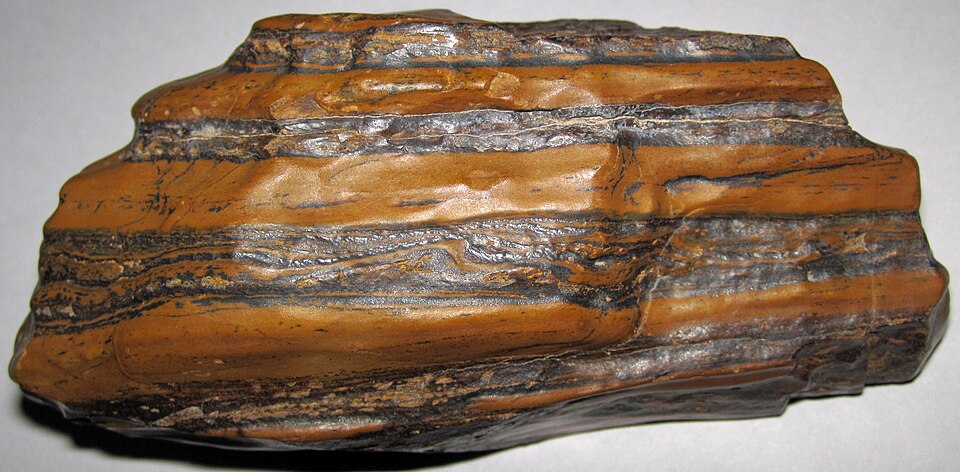
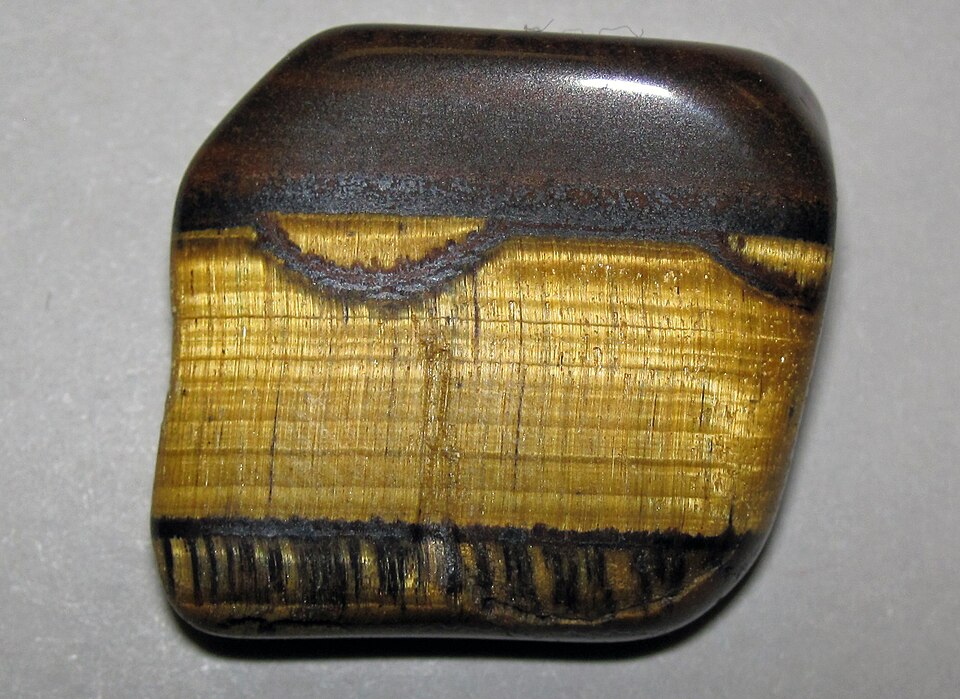
Key differences between Banded Iron Formation and Tiger's Eye
- Tiger's Eye is harder (Mohs 7) than Banded Iron Formation (Mohs 5–7), so Tiger's Eye will scratch Banded Iron Formation and not the other way round. It is about as hard as window glass: a knife barely marks it, while a steel file (Mohs 6.5) will.
- Streak color differs: Banded Iron Formation leaves a reddish brown (from hematite-rich layers) streak on unglazed porcelain, Tiger's Eye leaves white.
- Luster is different: Banded Iron Formation is vitreous (chert bands) to metallic/dull (iron oxide bands) while Tiger's Eye is silky.
- Banded Iron Formation feels noticeably heavier for its size (specific gravity 3.0–3.9 versus 2.65 for Tiger's Eye).
- Hold a thin edge to the light: Banded Iron Formation is Opaque, Tiger's Eye is opaque.
- They overlap in red and brown, but Banded Iron Formation also comes in black and gray and Tiger's Eye also comes in yellow.
Banded Iron Formation vs Tiger's Eye properties
| Property | Banded Iron Formation | Tiger's Eye |
|---|---|---|
| Type | Sedimentary Rocks | Quartz Family |
| Mohs hardness | 5–7 | 7 |
| Luster | Vitreous (chert bands) to metallic/dull (iron oxide bands) | silky |
| Streak | Reddish brown (from hematite-rich layers) | White |
| Transparency | Opaque | opaque |
| Specific gravity | 3.0–3.9 | 2.65 |
| Crystal system | — | hexagonal |
| Common colors | Red, Reddish brown, Black, Gray, Silver-gray banding | Golden Brown, Yellow, Red |
| Rarity | common | common |
| Typical specimen value | $1–$75+ | $5–$100+ |
Which is more valuable?
Tiger's Eye is usually the more valuable of the two: a typical collector specimen runs about $20 against $10 for Banded Iron Formation, and premium Tiger's Eye can reach $100 or more.
About Banded Iron Formation
Banded iron formation, often abbreviated BIF, is a chemically precipitated sedimentary rock built of alternating thin layers of iron oxides, typically hematite or magnetite, and iron-poor chert or jasper. It formed almost exclusively during the Precambrian, mostly between roughly 3.8 and 1.8 billion years ago, when ocean chemistry and atmospheric oxygen levels differed drastically from today. The striking red-and-silver or red-and-black banding records cyclical shifts in ancient seawater chemistry rather than annual sedimentary layering as in a typical varve.
About Tiger's Eye
Tiger's eye is a chatoyant gemstone displaying a silky luster and banded appearance. The optical effect resembles a cat's eye or tiger's eye.
Banded Iron Formation vs Tiger's Eye FAQ
Is Banded Iron Formation the same as Tiger's Eye?
No. Banded Iron Formation is a sedimentary rock while Tiger's Eye is a quartz family. Tiger's Eye is harder (Mohs 7) than Banded Iron Formation (Mohs 5–7), so Tiger's Eye will scratch Banded Iron Formation and not the other way round. It is about as hard as window glass: a knife barely marks it, while a steel file (Mohs 6.5) will.
How can you tell Banded Iron Formation from Tiger's Eye?
Tiger's Eye is harder (Mohs 7) than Banded Iron Formation (Mohs 5–7), so Tiger's Eye will scratch Banded Iron Formation and not the other way round. It is about as hard as window glass: a knife barely marks it, while a steel file (Mohs 6.5) will. Streak color differs: Banded Iron Formation leaves a reddish brown (from hematite-rich layers) streak on unglazed porcelain, Tiger's Eye leaves white. Luster is different: Banded Iron Formation is vitreous (chert bands) to metallic/dull (iron oxide bands) while Tiger's Eye is silky.
Which is harder, Banded Iron Formation or Tiger's Eye?
Tiger's Eye is harder: Mohs 7 against Mohs 5–7 for Banded Iron Formation.
Which is more valuable, Banded Iron Formation or Tiger's Eye?
Tiger's Eye is usually the more valuable of the two: a typical collector specimen runs about $20 against $10 for Banded Iron Formation, and premium Tiger's Eye can reach $100 or more.

