
Comparison · Minerals
Albite vs Dioptase
Albite and Dioptase are easy to confuse because both are minerals. Albite is harder (Mohs 6–6.5) than Dioptase (Mohs 5), so Albite will scratch Dioptase and not the other way round. A steel knife blade (Mohs 5.5) scratches it; a copper coin does not. Below is a side-by-side comparison of their properties and the quick tests that separate them.
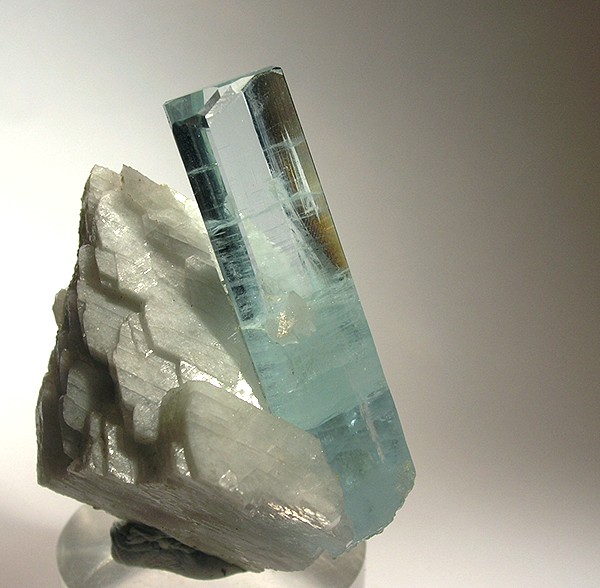
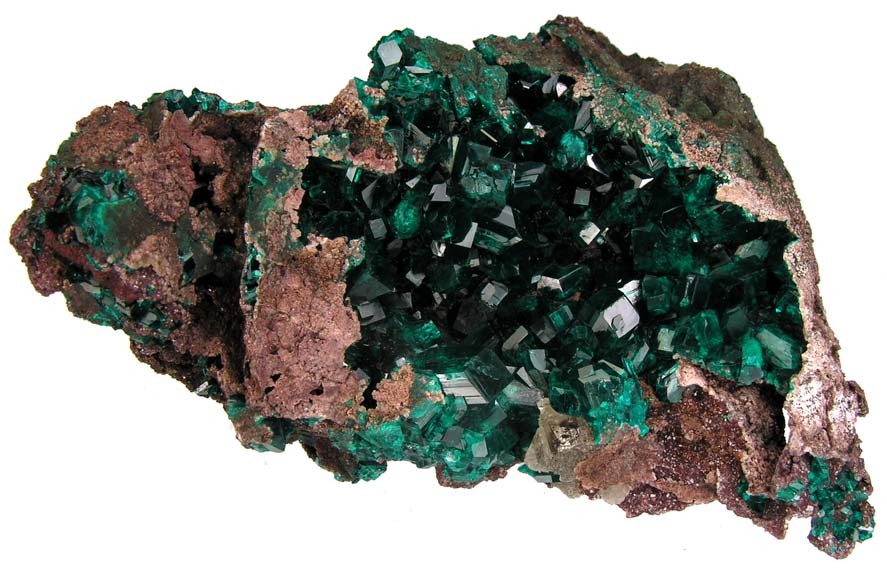
Key differences between Albite and Dioptase
- Albite is harder (Mohs 6–6.5) than Dioptase (Mohs 5), so Albite will scratch Dioptase and not the other way round. A steel knife blade (Mohs 5.5) scratches it; a copper coin does not.
- Streak color differs: Albite leaves a white streak on unglazed porcelain, Dioptase leaves green.
- Dioptase feels noticeably heavier for its size (specific gravity 3.28–3.35 versus 2.60–2.65 for Albite).
- They overlap in green, but Albite also comes in clear, gray, and blue.
- Well-formed crystals give it away: Albite is Triclinic, Dioptase is Trigonal.
Albite vs Dioptase properties
| Property | Albite | Dioptase |
|---|---|---|
| Type | Minerals | Minerals |
| Mohs hardness | 6–6.5 | 5 |
| Luster | Vitreous, pearly on cleavage | Vitreous |
| Streak | White | Green |
| Transparency | Transparent to translucent | Transparent to translucent |
| Specific gravity | 2.60–2.65 | 3.28–3.35 |
| Crystal system | Triclinic | Trigonal |
| Common colors | White, Colorless, Gray, Greenish, Pale blue (rare) | Emerald green, Bluish green |
| Rarity | common | common |
| Typical specimen value | $2–$150+ | $2–$150+ |
Which is more valuable?
Typical specimens of Albite and Dioptase trade in a similar range, around $20.
About Albite
Albite is the sodium-rich end-member of the plagioclase feldspar series, with the formula NaAlSi3O8, forming a continuous solid-solution series with the calcium end-member anorthite. It typically appears as white, cream, or pale gray tabular crystals with two cleavage directions meeting near a right angle. Its low density and glassy luster set it apart from denser silicates, and it is a defining component of many granites, gneisses, and pegmatites.
About Dioptase
Dioptase is a copper cyclosilicate mineral, Cu6Si6O18·6H2O, prized for an intense emerald-green color that rivals fine emerald despite being a completely different mineral species. It forms in the oxidized zones of copper ore deposits under arid conditions, typically as small but brilliantly lustrous crystals. Dioptase is too soft and brittle to be widely used as a gemstone, so its value lies almost entirely with mineral collectors.
Albite vs Dioptase FAQ
Is Albite the same as Dioptase?
No. Both are minerals, but they are distinct species with different hardness, streak or luster. Albite is harder (Mohs 6–6.5) than Dioptase (Mohs 5), so Albite will scratch Dioptase and not the other way round. A steel knife blade (Mohs 5.5) scratches it; a copper coin does not.
How can you tell Albite from Dioptase?
Albite is harder (Mohs 6–6.5) than Dioptase (Mohs 5), so Albite will scratch Dioptase and not the other way round. A steel knife blade (Mohs 5.5) scratches it; a copper coin does not. Streak color differs: Albite leaves a white streak on unglazed porcelain, Dioptase leaves green. Dioptase feels noticeably heavier for its size (specific gravity 3.28–3.35 versus 2.60–2.65 for Albite).
Which is harder, Albite or Dioptase?
Albite is harder: Mohs 6–6.5 against Mohs 5 for Dioptase.
Which is more valuable, Albite or Dioptase?
Typical specimens of Albite and Dioptase trade in a similar range, around $20.

